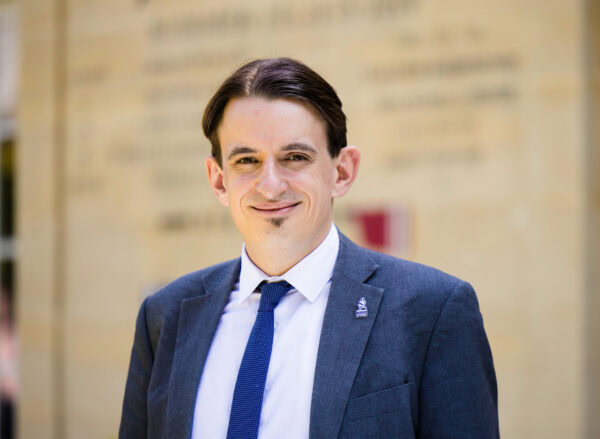
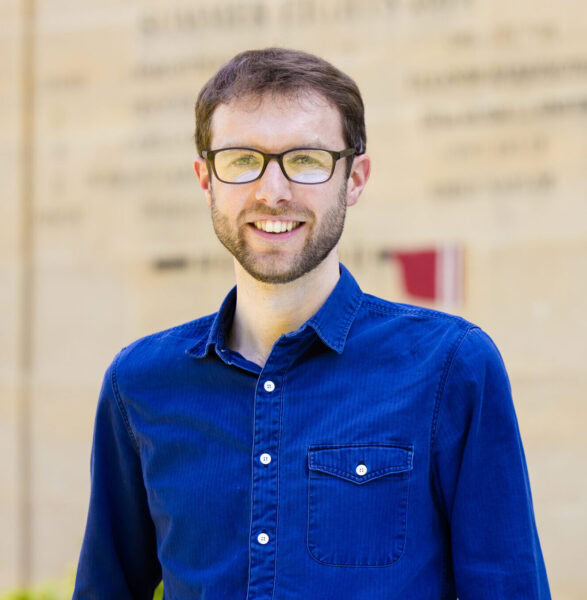
On 26 June 2026 the Lab welcomed a delegation from Hong Kong Baptist University (HKBU) to Regent’s Park College: Professor Daniel Lai, Dean of the Faculty of Arts and Social Sciences, Professor Zhou Jiajia (Academy of Wellness and Human Development) and Ms Alice Wong (Faculty of Arts and Social Sciences), joined online from Hong Kong by Professor Wong Man Kong, historian of HKBU and of British Baptist missionaries in China. The visit followed Professor Pieter François’s keynote lecture at HKBU in March and brought the two institutions together around a shared interest in the digital humanities, AI and the history of the Baptist world.
The afternoon began in the Angus Library and Archive, the College’s internationally important collection on the history of the Baptist movement, where the archivists gave the visitors a private tour and showed a selection of some twenty items on China from the 1840s to the 1950s: letters, pamphlets, photographs, manuals and testimonies, drawn from more than thirty running metres of material on China that has hardly been used and that digital humanities methods can now open up.
Back in the meeting room, the Director introduced the Lab, presented the Seshat Global History Databank and the Lab’s benchmarking of large language models on historical knowledge, and gave an overview of the Lab’s wider portfolio: from generational patterns in authorship and
Indigenous Peoples and the CARE principles to the Neo-Alexandria digital library, AI for lesson plans, the Great Divergence and the AI Historian, empires in comparative perspective, and the AI Diplomat. Four Lab members then showcased current projects:
- Sabbir Saown – Religion, Power, Time: an exploratory instrument for comparing religious coercion across history and the present day, built on the religious-tolerance variables of the Seshat Global History Databank and the Pew Research Center’s indices (with Enrico Cioni, Dr Rachel Ainsworth and Pieter François).
- Dr Matilda Peruzzo – The Estimator project: modelling historical diffusion from geographic characteristics, testing the Diamond and Bates hypotheses on how crops, animals and technologies spread.
- Jianing (Brian) Shi – Exploring travel history through the AI Historian: a case study on 668 nineteenth-century British travel books, in which an AI system extracts the places visited and reconstructs itineraries to ask whether mass travel really made journeys uniform.
- Dr Giovanna Di Martino – The Data/Culture project: building sustainable scholarly communities around Arts and Humanities datasets and software.
The talks were followed by a discussion of how the two institutions can work together on digital humanities projects, including the Angus Library’s China material, and the day closed with drinks and a private dinner hosted by the Principal, Sir Malcolm Evans, at the Principal’s Lodge.