Faith and Identity Across Eight Decades: An Interview with Ray Vincent (1957, Theology) for LGBTQ+ History Month
Date: 16/02/2026
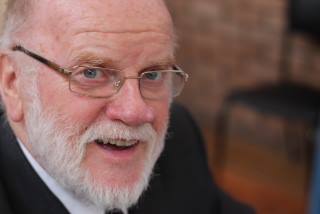
When Ray Vincent (1957, BA Theology) was named Stonewall’s Gay Role Model of the Year in 2019, it marked a moment of visibility that had taken more than eight decades to reach. By this time, Ray was in his 80s, had spent a lifetime in Baptist ministry, and had only recently begun living more openly as a gay man.
For Ray, that recognition was not about personal fame – though he does joke about his ‘five minutes of fame’ – but about visibility, confidence and empowering others. His life tells a story that sits at the intersection of faith, sexuality and social change, and offers a powerful reflection for LGBTQ+ History Month.
The path to Regent’s
Ray grew up in the South Wales valleys, where Baptist churches were central to community life. Ministers were highly respected local figures, and from a young age, Ray imagined himself becoming one. “Everybody patted me on the back for it,” he recalls. “It was an ambition of mine, really.”
His academic journey was not a straightforward one. Beginning his studies at Bangor University in North Wales, Ray learned from a Tutor about Regent’s Park College, at the University of Oxford. “I thought it was a very funny name,” he chuckles. “I always thought that was a zoo!” But he applied, was accepted, and soon found himself studying theology at Oxford.
Regent’s in 1957 was very different to today. Having only recently become a PPH, it was a small, close-knit community, made up mostly of ministerial students and a few lay students. Ray remembers his student days with great affection: “There was a very close friendship among the students. And Oxford is such a wonderful place! I thoroughly enjoyed it.”
Foundations in theology, ministry and identity
Ray’s time at Regent’s was intellectually formative. He speaks especially warmly of Gwynne Henton Davies (1906-1998), the then Principal, whose Old Testament lectures were among the most popular in the University. “He really brought the Bible alive”, Ray says. “He stirred up a tremendous interest in the Old Testament for me.”
But alongside this enthusiasm sat quiet uncertainty. Ray was wrestling with the idea of being ‘called’ to ministry, and decided to stay on for further academic study. Whereas others spoke of an inescapable summons, which left them with no choice but to train for ministry, for Ray, this was a deeply desired path. At the same time, he was also grappling with something more private.
It was during his teenage years – around the same time that he recommitted to his Christian faith and decided to pursue theological study – that Ray became aware he was homosexual. “We didn’t use the word ‘gay’ in those days,” he explains. “And it was a very different world.”
At the time, sex between men was a criminal offence. Ray believed in his faith deeply and did not hold it in tension with his sexuality, but he did not think that being openly gay was compatible with being a Christian minister. At Regent’s, he felt unable to tell anyone. “I was very much closed up,” he says. “I’ve discovered since then that there were others who were also gay – but we didn’t know about each other.” (In fact, years after graduating, Ray got back in contact with several fellow Regent’s students who are now open about their sexuality).
Ministry and continued learning
After leaving Regent’s, Ray went on to serve ministry for decades. Throughout his career, he made careful, often courageous choices. He never preached against homosexuality. Even when it was not discussed in churches at all, he dared to mention it – cautiously, but deliberately.
His faith, Ray says, was never the problem. “I never thought of my sexuality as a sin. The experience of being gay has been so lovely and beautiful.” Ray found great comfort in his faith during times of loneliness and misunderstanding. What caused anxiety were the unknown possible reactions.
But there were moments of quiet encouragement. Ray remembers one elderly congregant who would approach him after services when he mentioned homosexuality. “One more step in the Church’s education”, he would say.
Alongside his career in ministry, Ray kept his academic interest in theology alive. Ray made a point to buy a new book once a month, and committed to reading for an hour or so every week. His interests developed, and he went to Glasgow University as a mature student to complete an MTh, his research focussing on the Canon of the New Testament.
Coming out: slowly, then fully
It was after his retirement that things began to change more quickly. Ray joined the chaplaincy team at the University of South Wales and, encouraged by colleagues, became increasingly open about his sexuality. He helped establish the University’s LGBTQ+ staff network and began speaking out publicly as a gay man.
Later, he came out to his church – a moment met not with rejection, but celebration. For one of their regular film and discussion nights, the church put on a film about gay men in the US, and Ray volunteered to be interviewed afterwards, talking about himself and his experiences. “It was a wonderful reception,” he says.
In 2019, Ray’s work with the LGBTQ+ network was recognised nationally when he was named Stonewall’s Gay Role Model of the Year. The award brought media attention, public congratulations, and above all else: a sense that his story mattered to others.
Ray realised how important sharing his story was, especially for younger LGBTQ+ people, especially people of faith, who might struggle to see a future for themselves where they can be open, accepted, and proud. “I can relate to young [LGBTQ+] people in a way that sometimes a parent can’t always; on a different level.”
From that point on, Ray was fully out for the first time, over the age of 80.
Ray’s reflections
Looking back, Ray is proud of his independence, integrity and honesty. He never denied who he was. “I wouldn’t hide it if I were asked the question directly. If someone asked, “Are you gay?”, I would say yes. While he was in the closet, Ray never preached against homosexuality, and throughout his life he has built long-lasting and meaningful friendships.
What advice would Ray give to young LGBTQ+ people today? “I would say, come out if you feel able. It’s definitely worth it. Do it as soon as you can, and you might be surprised by the support you get.”
Ray’s story reminds us that openness is not always immediate – sometimes it’s a lifelong unfolding. His journey shows that faith and identity need not be adversaries. Across decades of ministry, doubt, growth and change, Ray has remained committed to his faith, to himself, and to other people. For LGBTQ+ History Month, we celebrate his courage, his ministry, and the freedom he has found in living openly. With thanks to Ray for sharing his story.