Regent’s Doctoral Researcher Illia Chernohorenko speaks at a Westminster panel on reparations for Ukraine
Date: 6/03/2026
Illia Chernohorenko, a DPhil candidate in Law based at Regent’s Park College, addressed senior UK parliamentarians in Westminster on Tuesday 24 February, marking four years since the Russian invasion of Ukraine.
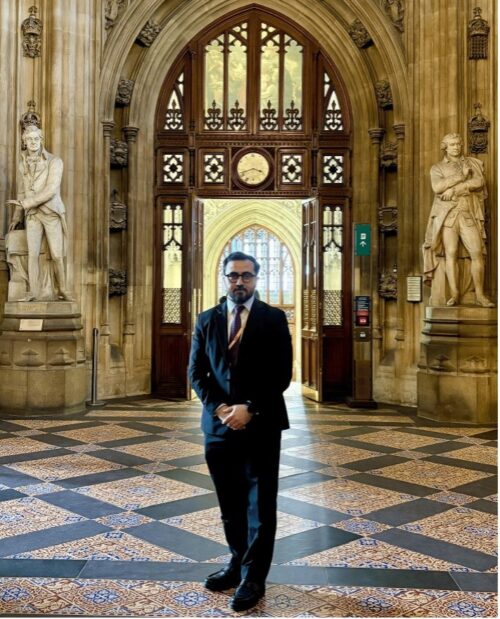
Illia at Westminster
The event, organised by the international human rights organisation REDRESS, chaired by Sir Iain Duncan Smith MP, and hosted by the All-Party Parliamentary Group on Magnitsky Sanctions and Reparations, brought together several MPs, peers and leading NGOs to discuss how the UK can support justice and reparations for Ukrainian survivors of serious human rights violations.
Discussions focused particularly on survivors of torture and conflict-related sexual violence, many of whom have yet to receive any compensation.
Illia spoke alongside Lyra Nightingale of REDRESS and Iryana Dovgan of SEMA Ukraine (the Global Network of Victims and Survivors to End Wartime Sexual Violence). The panel examined emerging international mechanisms to compensate Ukraine for the immense damage caused by the war.
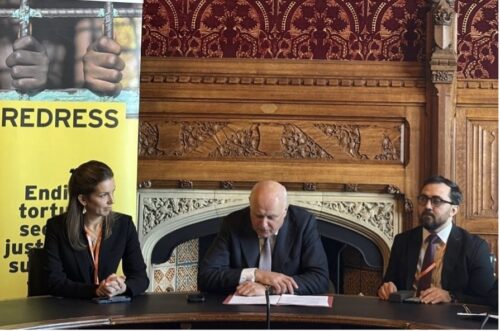
Lyra Nightingale (REDRESS), Sir Iain Duncan Smith MP, and Illia Chernohorenko
Drawing on the latest international assessment carried out jointly by the Government of Ukraine, the World Bank, the European Commission and the United Nations, Illia highlighted the scale of the challenge. Ukraine’s reconstruction and recovery needs are now estimated at $588 billion over the next decade – almost three times the country’s GDP for 2025.
Around 110,000 compensation claims have already been submitted, with between six and ten million expected in total. If realised, this would become the largest mass claims process in modern European history.
Illia emphasised the importance of moving quickly to establish an International Claims Commission for Ukraine. “Ratify early. Meet the financial threshold. Activate the Commission. Turn responsibility into remedy. That is how the legal order answers aggression.”
Illia’s doctoral research examines how assets linked to aggressor states can lawfully be repurposed to provide redress for violations of international law. Before beginning his DPhil, he worked at the highest levels of justice reform in Ukraine. Illia served as Director-General for the Rule of Law Directorate at Ukraine’s Ministry of Justice and later advised the President of Ukraine on legal reform. He also acts as a Reporter for the European Law Institute’s Guiding Principles on Seizing and Confiscating Sanctioned Assets.
His invitation to speak at Westminster reflects both his professional experience and the global relevance of his research at Regent’s Park College, and the significance of the discussion lies far beyond academia or policy. For survivors of conflict-related violence, Illia argues, the creation and implementation of an effective compensation mechanism would mark not only financial redress, but recognition: a tangible affirmation that international law can still deliver justice in the face of aggression. As he told parliamentarians, responsibility must be turned into remedy, swiftly.